
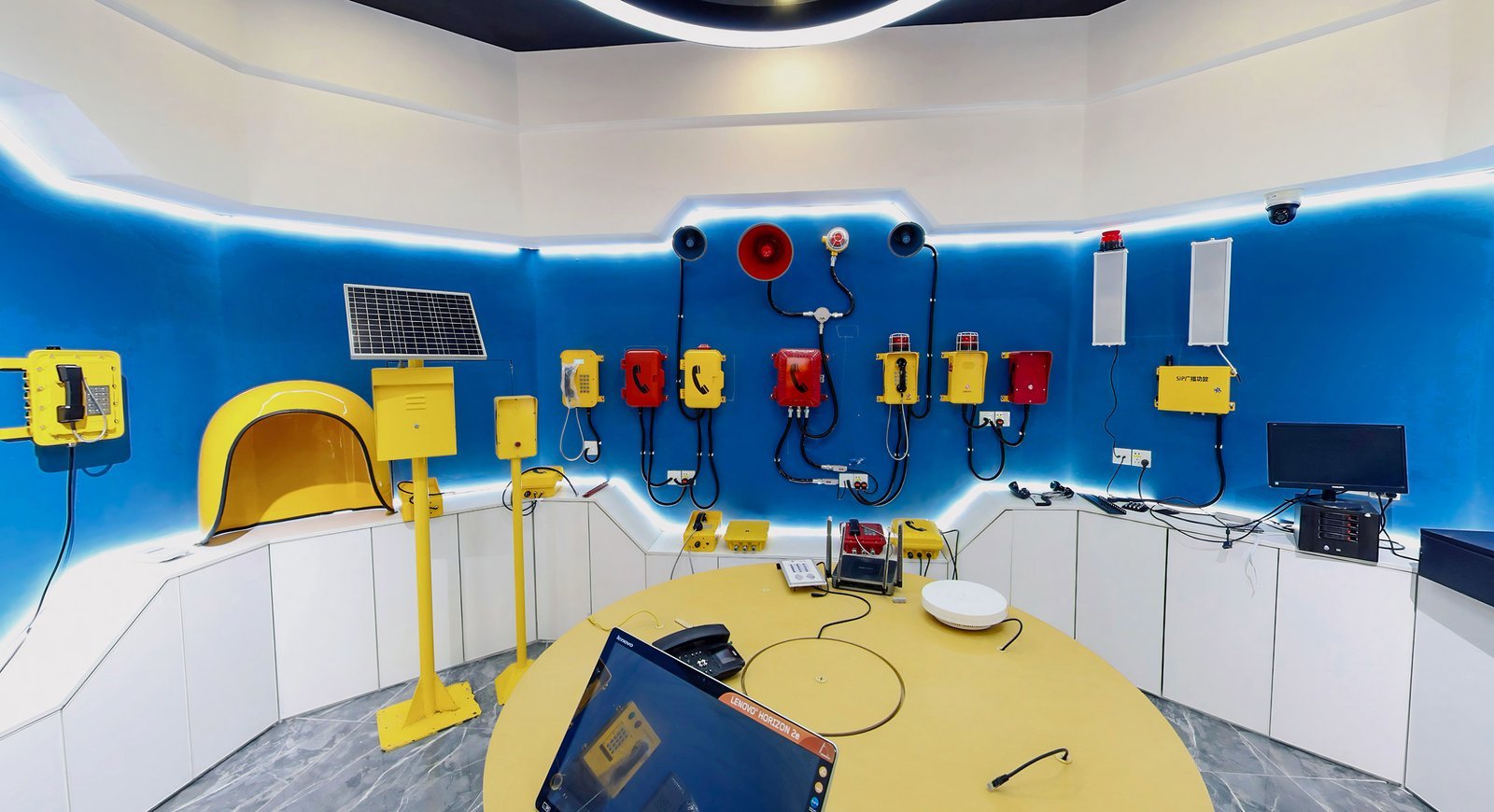
An emergency telephone system often has to connect terminals spread across different areas, or link them back to a control room. When the devices are far apart, a dedicated cable run is not always practical.
Where IP networks earn their place
IP networks are commonly used where wide-area connectivity is required: outdoor emergency call boxes, elevator SOS intercoms, industrial ATEX telephones and other distributed call points.
In an IP network, every communication terminal connects through a network cable, and calls travel over the network. It works in a similar way to communication between computers: each device may sit on its own local network, but as long as it has a path to the wider network, distance and LAN boundaries stop being the limiting factor.
One server, many addresses
The connection needs one IP server, also connected to the network. The server’s number range is assigned to the terminals, and each terminal has an address on the network. Through the server’s IP address, the link between the terminals and the server can also be wireless and unaffected by distance.
The number of terminals depends on the performance of the IP server rather than on the length of a cable. That makes the architecture straightforward to extend as a site grows.
Why wireless links work
Because the server is addressed on the network rather than reached through a fixed physical circuit, the path between a terminal and the server can cross a wireless bridge. That is useful on construction tunnels, temporary sites and spread-out outdoor installations where pulling fiber would be slow or expensive.
Safecom has focused on the communications field for more than 15 years, with emergency telephones and explosion-proof telephones built to international quality standards.