
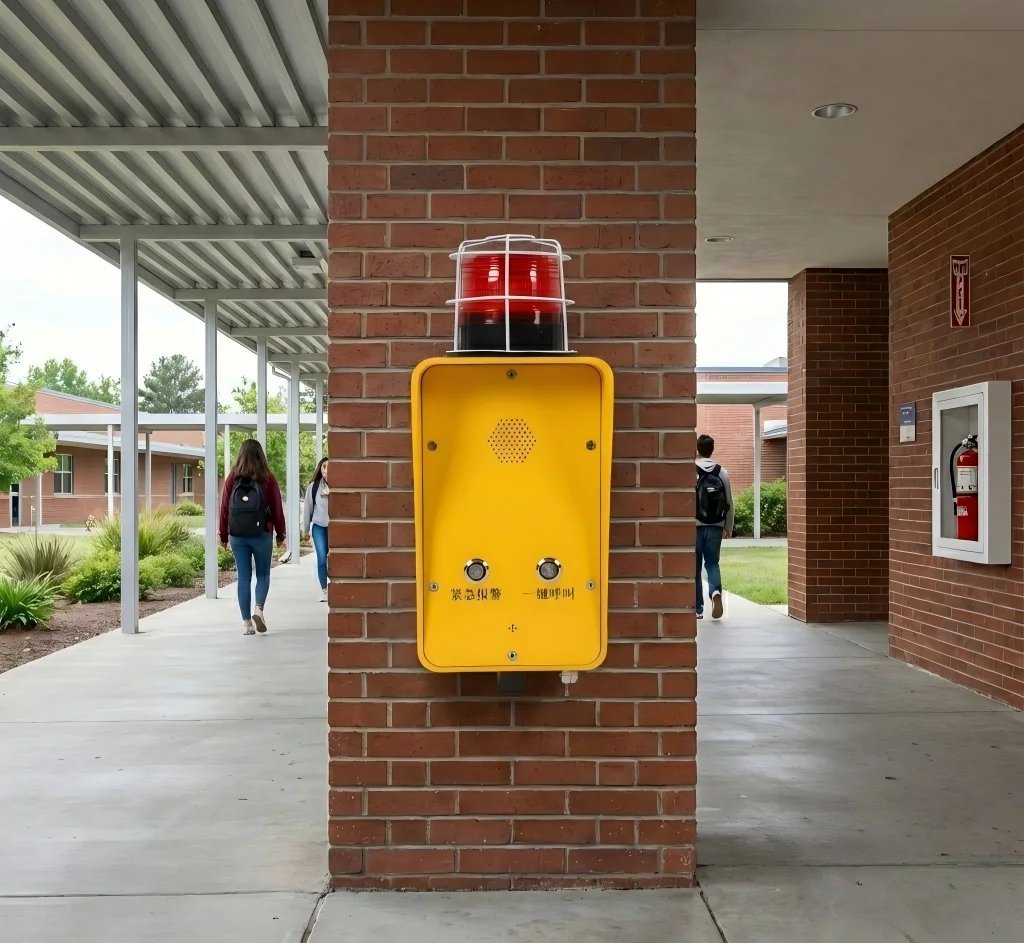
In the construction of the Industrial Internet and smart cities, emergency communication systems, as a key component of the underlying infrastructure, undertake dispatching and communication functions. Unlike civilian communication equipment, industrial-grade communication terminals have strict specifications regarding hardware protection standards, protocol compatibility, and system redundancy.
Industrial communication equipment must maintain a high mean time between failures (MTBF) under extreme physical environments. Its core technical indicators typically cover the following dimensions:
- Protection Rating (IP Rating): According to the IEC 60529 standard, terminals typically need to reach IP66 or IP67 levels to ensure the sealing of internal circuits in high-pressure spray, high humidity, and dusty industrial environments.
- Shock Resistance (IK Rating): Utilizing a high-strength aluminum alloy or stainless steel die-cast shell, the shock resistance rating must reach IK10 to cope with the physical damage risks in public security and heavy industrial sites.
- Electromagnetic Compatibility (EMC): For substation or large computer room environments, equipment must be able to withstand high-voltage surges, electrostatic discharge (ESD), and electromagnetic interference to ensure signal transmission stability.
Industrial communication systems have fully transitioned to VoIP (Voice over IP) architecture, primarily built on the standard SIP (RFC3261) protocol. That is the technology base for integration with smart-city and security platforms.
The technology stack behind the call
- Protocol standardization: Standard SIP ensures access to mainstream IP-PBX servers and IMS platforms such as Cisco, Avaya and Huawei.
- Audio and video linkage: Through ONVIF or a proprietary SDK, an emergency call can trigger the live video stream from the nearest camera, enabling visual dispatch.
- Power and cabling: IEEE 802.3af/at PoE carries both data and power over one network cable, reducing cabling complexity and maintenance effort.
Engineering for tunnels and noisy sites
In tunnel communication integration, the system needs to address technical challenges such as long-distance transmission and high background noise.
- Acoustic processing: A DSP module uses adaptive echo cancellation (AEC) and noise reduction (NR) to keep speech intelligible above 90 dB of traffic noise.
- Network topology: A self-healing ring switches paths within milliseconds if a single optical cable fails, keeping the communication link alive.
- System functions: The dispatch center can receive emergency calls and broadcast to different tunnel zones through the PA system to guide evacuation.
From help terminal to edge sensing node
With the deepening of smart city construction, the function of industrial communication telephones is evolving from a simple “help terminal” to an “edge sensing node.” By integrating various sensors (such as temperature, humidity, smoke, and gas detectors), the equipment can provide two-way voice communication while uploading environmental data in real time, providing decision support for security integration platforms.
Industrial communication systems are a technology field that emphasizes high determinism and environmental adaptability. Choosing products with high protection standards and standard protocol support is crucial to ensuring safety in industrial sites and urban public spaces.